

"Hedge maze in Parque São Roque da Lameira" by Joseolgon, CC0, via Wikimedia Commons.

News
Hours after OpenAI's claim, Anthropic released its own claimed disproof of a famous computer science assumption, with the paper credited to "Claude, Anthropic."
On Monday night, Anthropic posted a paper titled "A 2^o(n) Time Algorithm for 3-SAT," credited to "Claude, Anthropic."
On Monday night, Anthropic posted a paper titled "A 2^o(n) Time Algorithm for 3-SAT," credited to "Claude, Anthropic," along with a computer-checkable version of the proof on GitHub (Anthropic on GitHub, paper on Hexagon).
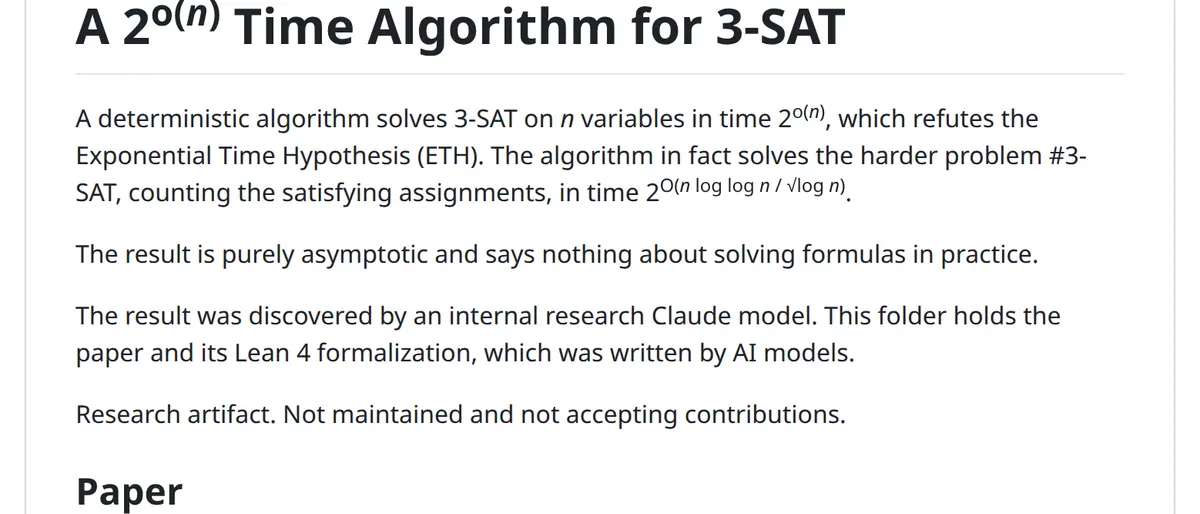
It claims to refute the Exponential Time Hypothesis (ETH), the long-standing assumption that a classic logic puzzle called 3-SAT can't be solved much faster than trying every possible answer. That's the same hypothesis OpenAI said its model disproved earlier Monday (our Oct 26 post). The paper says an internal Claude research model found the core method on October 16 "with 14M output tokens and no human input," and that researchers then worked with Claude on the write-up.
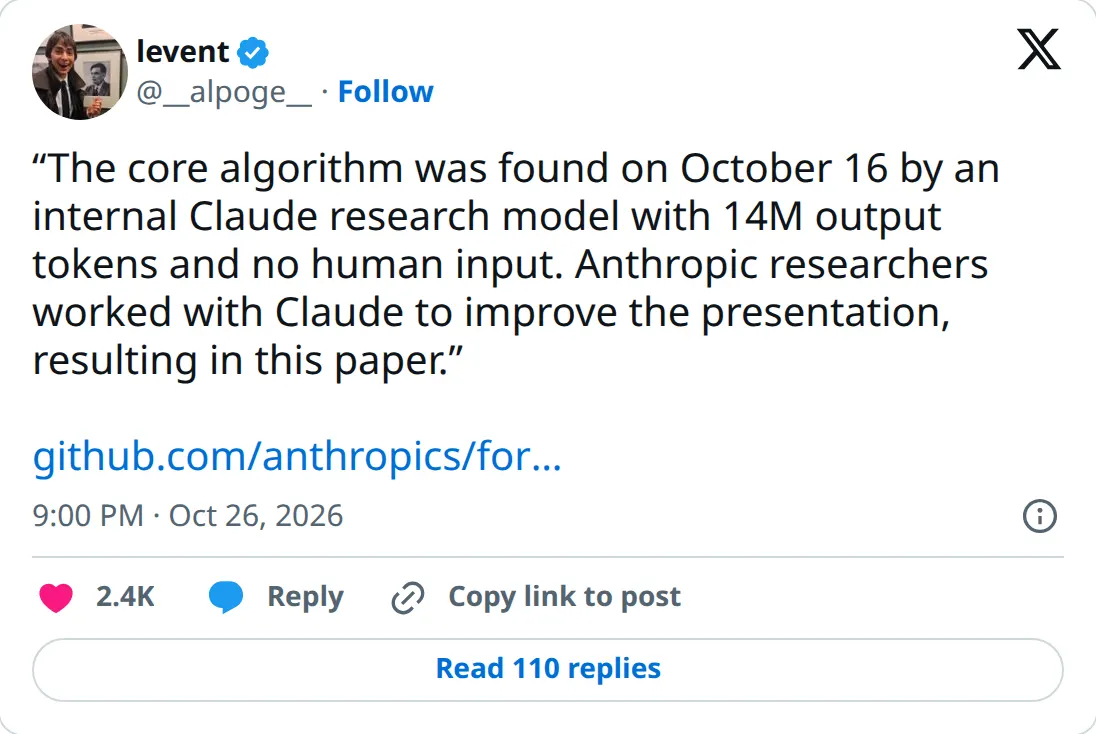
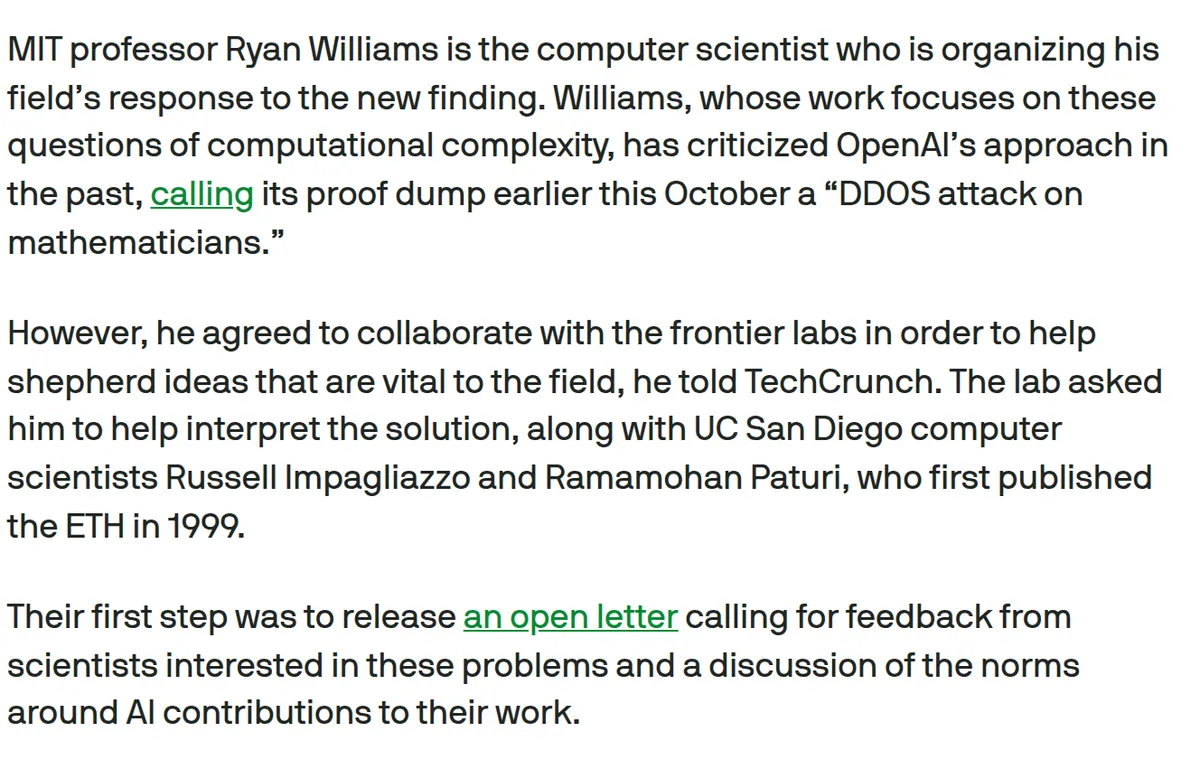
It calls the two results independent and concurrent (Levent Alpöge, Anthropic, on X). The proof was formalized in Lean, a language where a computer checks every step. The paper also says the Lean code was written and reviewed by AI models and "no person is known to have checked it" yet. MIT's Ryan Williams and ETH's original authors, Russell Impagliazzo and Ramamohan Paturi, are organizing an open review of the claims, and their open letter says their involvement "should not be taken as certification" (TechCrunch explainer on both claims).
What to weigh: this is a claim, not a confirmed result, and nobody outside either lab has confirmed it yet. Even if it holds, Anthropic says the gain is "purely asymptotic" (it only shows up on gigantic problems), and its paper says it doesn't beat brute force unless a formula has more than 10 billion variables. So nothing about everyday software or encryption changes now.
Affiliate disclosure: some stories use affiliate or referral links. When a link pays a commission, the sentence next to it says so. Sponsored slots are labeled Sponsored. The channel card is a house ad until a sponsor is booked.
Newsletter
Join the waitlist and we'll email you when the first issue launches.
By submitting you agree to our Privacy Policy.
You're on the list after you confirm. We'll email you when the newsletter launches. You can leave from any message. The form posts to Resend.