

"Red jigsaw puzzle piece on green pieces" by Profpcde, CC0, via Wikimedia Commons.

News
OpenAI says an internal model disproved a major computer science conjecture and proved long-open math and physics results, and outside researchers will now check the work in the open.
On Monday afternoon OpenAI said an internal AI system produced three new results, none of them peer reviewed yet.
On Monday afternoon OpenAI said an internal AI system produced three new results, none of them peer reviewed yet (OpenAI, The Verge).
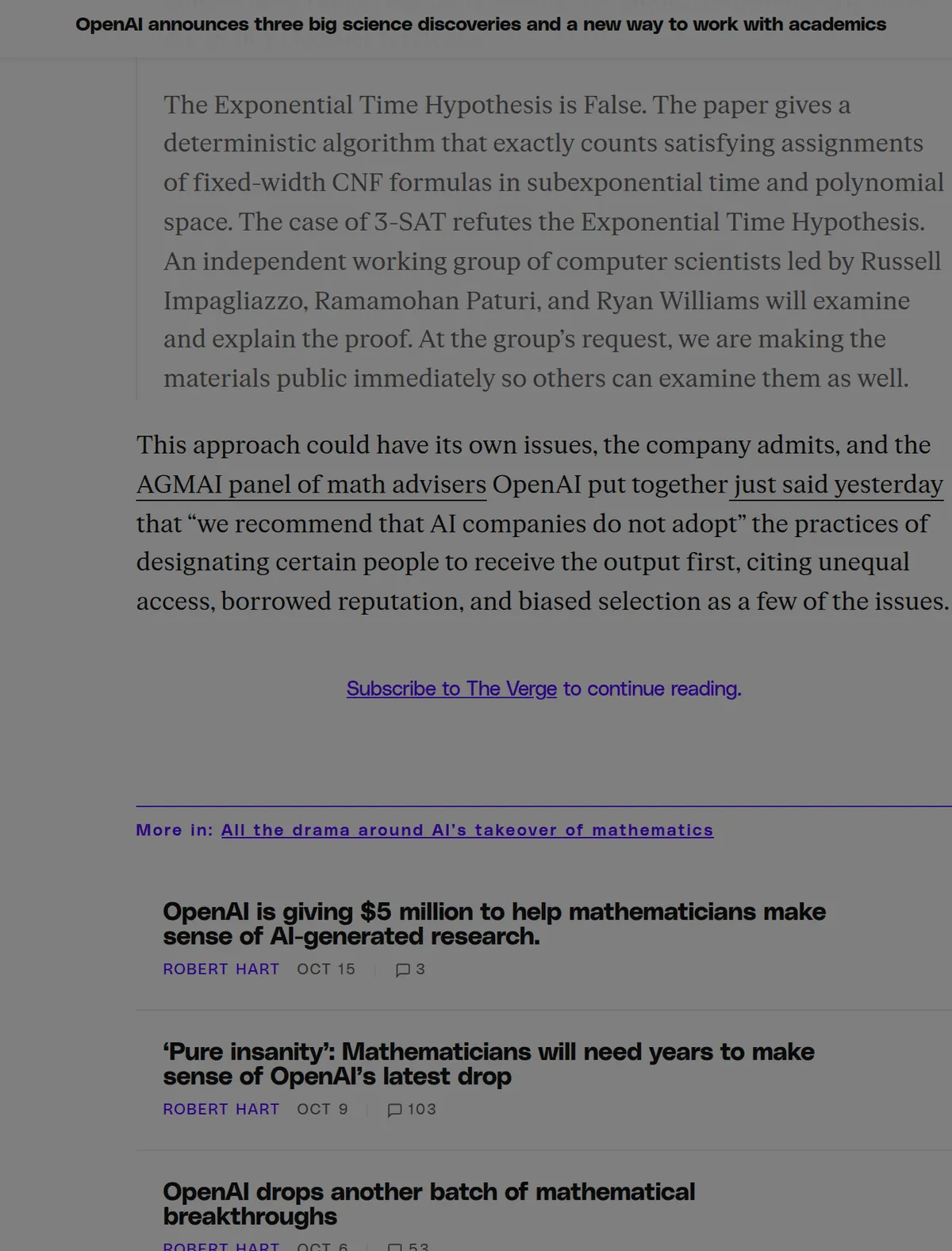
The headline claim is a disproof of the Exponential Time Hypothesis (ETH), a 25-year-old assumption that some hard logic puzzles (3-SAT) can't be solved much faster than trying almost every answer. OpenAI says the proof checks out in Lean, a program that verifies math line by line, and it has posted the proof and Lean files publicly (OpenAI on GitHub). Russell Impagliazzo and Ramamohan Paturi, two of the researchers who first proposed ETH, and MIT's Ryan Williams will lead an open review, with no NDAs and no pay.
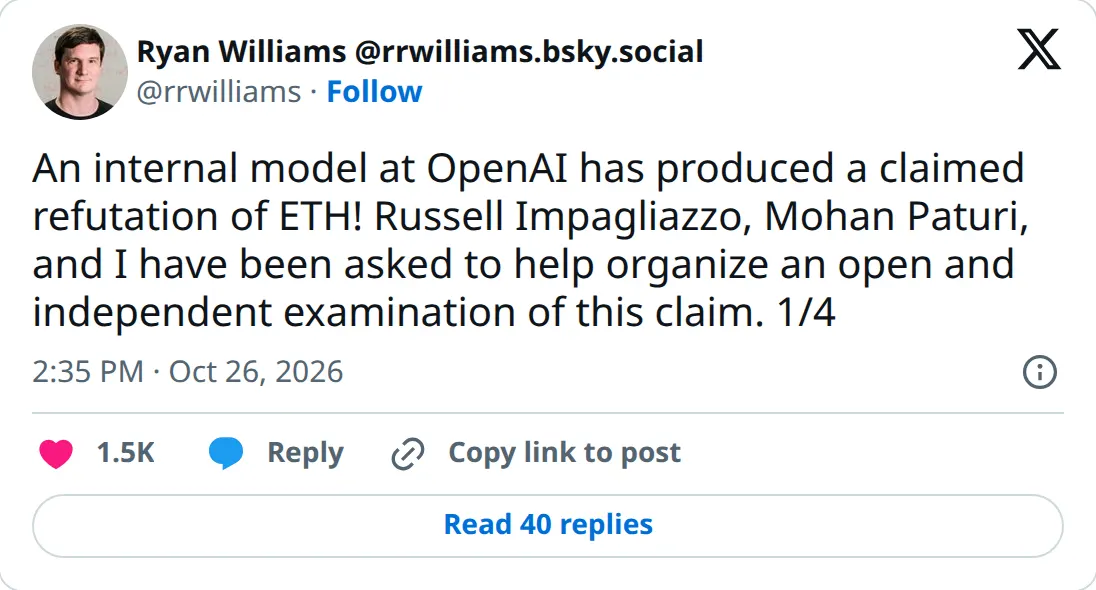
OpenAI also agreed to release all the raw material and sponsor a conference (Ryan Williams on X, thread). The second result is a claimed proof of Sogge's local smoothing conjecture in every dimension, which would also settle the Kakeya and Stein restriction conjectures. The third is a claimed existence proof for 4D quantum chromodynamics, the theory of the strong force. That includes the "existence" half of the Yang–Mills Millennium Prize problem, but not the mass gap, which is the other half. A group led by Nobel laureate David Gross will write up the physics, and OpenAI is holding those files back for now. OpenAI says it wants no academic credit, and that turning the ETH result into faster real-world solvers "will require significant further research."
What to watch: whether the outside checkers confirm the proofs. Lean checks the logic, but people still need to confirm the statements say what OpenAI claims. Williams says it's too early to know if this leads to faster SAT solvers, the tools behind chip design and scheduling software. He calls a "serious update" within 12 months "plausible," but adds, "Or we might not see anything like that" (Ryan Williams on X). Also worth watching: The Verge notes that OpenAI's own panel of math advisers recommended on Sunday that AI labs stop giving results to hand-picked experts first, and for now the physics files are going only to the Gross group.
Affiliate disclosure: some stories use affiliate or referral links. When a link pays a commission, the sentence next to it says so. Sponsored slots are labeled Sponsored. The channel card is a house ad until a sponsor is booked.
Newsletter
Join the waitlist and we'll email you when the first issue launches.
By submitting you agree to our Privacy Policy.
You're on the list after you confirm. We'll email you when the newsletter launches. You can leave from any message. The form posts to Resend.