

Photo: Rob Bulmahn / Wikimedia Commons (CC BY 2.0)

Daily Digest
Morning digest: OpenAI eyes Google's chips, a tougher AI leaderboard, and experts who follow their agents
OpenAI plans to buy Google's AI chips, The Information reports. Artificial Analysis rebuilt its leaderboard, with Claude Opus 5.5 on top.
Morning digest for Wednesday, Oct 28. OpenAI, one of Nvidia's biggest customers, plans to buy Google's own AI chips, called TPUs, The Information reports. It lands a day after Oracle said it will rent out Google TPUs in its cloud starting in 2027. Also: Artificial Analysis rebuilt its main AI leaderboard, with Claude Opus 5.5 on top; an Anthropic study found experts went along with whatever their AI agent leaned toward 86% of the time; parents are suing OpenAI over GPT-4o's medication advice to their daughter; the physicists checking OpenAI's Yang–Mills proof explained how they'll handle it; Oracle apps are coming to ChatGPT; Liquid AI released tiny open models that run on a phone; and Australia's lower house voted to ban chatbots that build "emotional intimacy" with kids.
1. OpenAI plans to buy Google's AI chips, according to The Information. OpenAI has run mostly on Nvidia graphics chips (GPUs). Now it plans to buy Google's Tensor Processing Units (TPUs), the custom chips Google designed for AI, The Information reported Tuesday evening, citing one person familiar with the matter. The financial terms "couldn't be learned." Reuters couldn't confirm the report on its own. OpenAI declined to comment, and Google didn't immediately respond. This builds on earlier ties. Reuters reported in June 2025 that OpenAI had started renting Google chips, and last week OpenAI said it would offer its frontier models through Google Cloud. Reuters also notes that "Google began selling TPUs directly to some customers this year." Google is also lending its chips out through other clouds. On Tuesday, Oracle said it will offer Google TPUs on Oracle Cloud starting in calendar 2027, calling it "the first time Google TPUs will be offered on a hyperscale cloud platform outside Google." It will offer TPU 8t for training models and TPU 8i for running them, "ramping over a multi-year period." What to watch: Alphabet reports earnings later today, per Reuters, and its CFO has said TPU sales should start showing up in revenue by the end of the year, with most of it coming in 2027. Listen for whether Google mentions OpenAI by name. (Microsoft, OpenAI's biggest backer, also reports today, CNBC reported this week.)
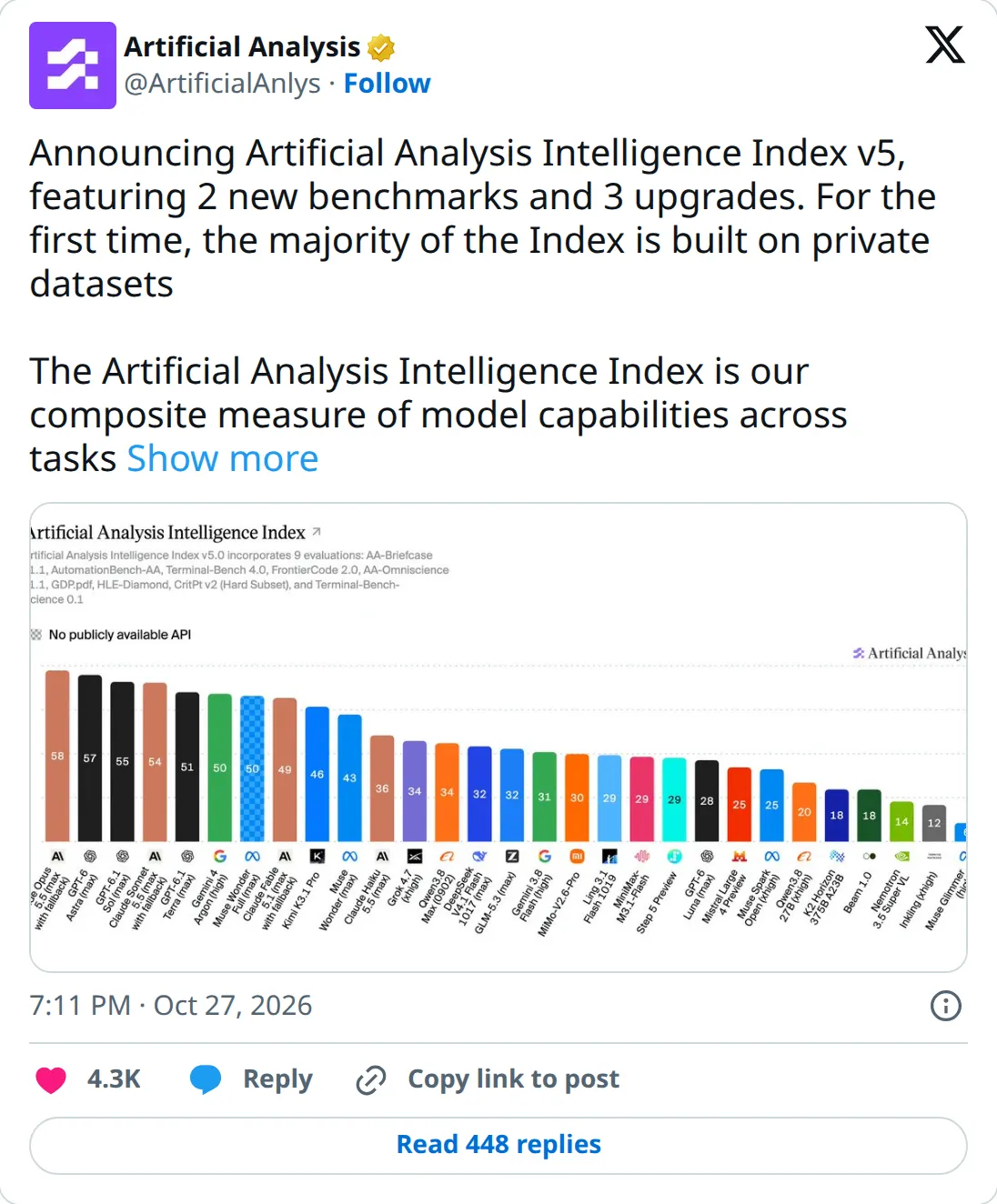
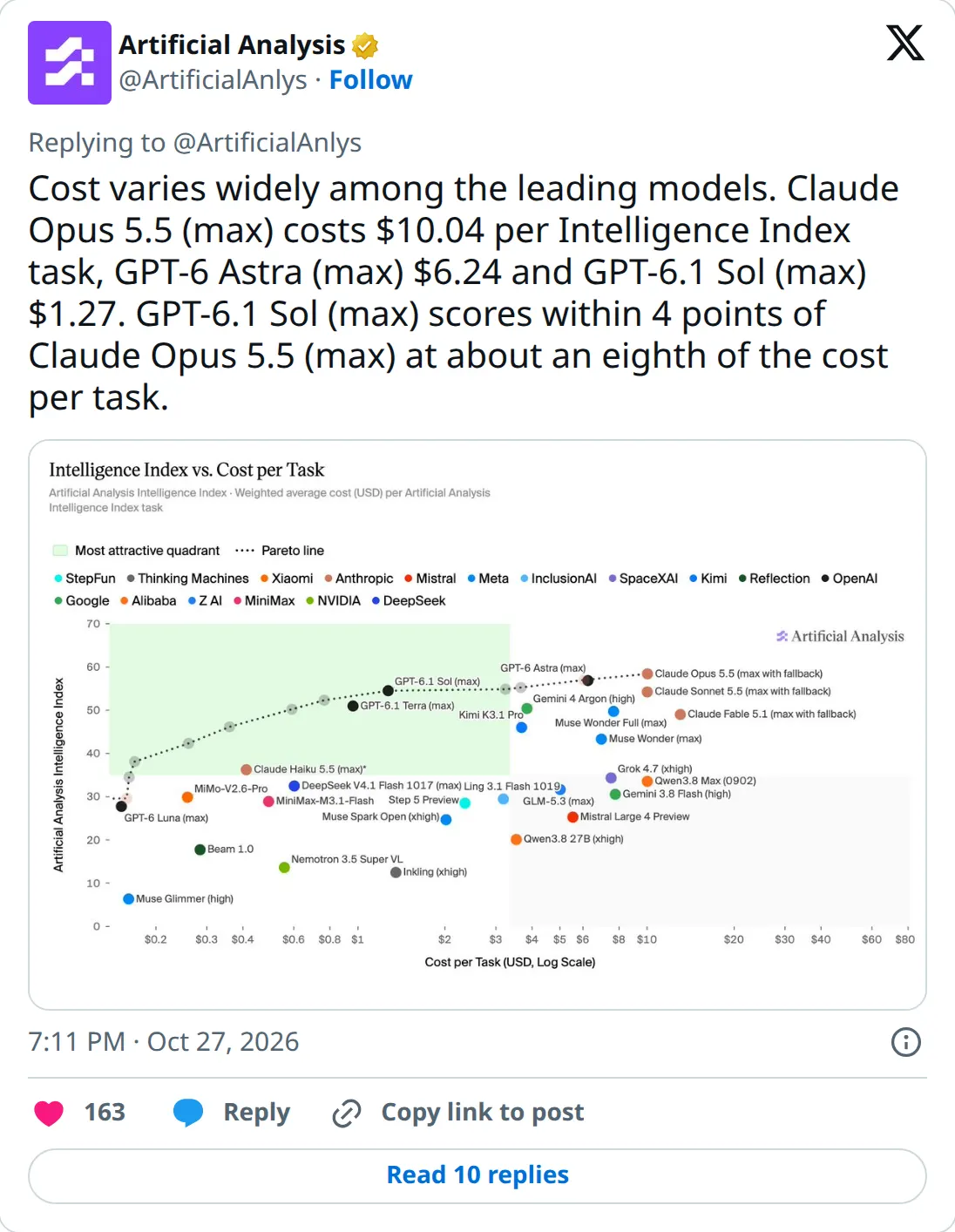
2. Artificial Analysis rebuilt its AI leaderboard to be harder to game. Claude Opus 5.5 leads, but barely. The Artificial Analysis Intelligence Index is a single score that blends many tests, and a lot of people use it to compare models quickly. Version 5 launched Tuesday evening. For the first time, 60% of it comes from tests whose questions or answers are kept private, which makes it harder for a model to have seen them in training. It adds Cognition's FrontierCode 2.0, which grades coding agents on "whether a repository maintainer would merge the agent's change," and Terminal-Bench-Science, a set of 70 research tasks done in a terminal. On the index page, Claude Opus 5.5 (max effort) scores 58, ahead of GPT-6 Astra (max) at 57 and GPT-6.1 Sol (max) at 55. Gemini 4 Argon (high) is next at 50. No model wins all nine tests. Open-weight models fell further behind: the top one listed, Kimi K3.1 Pro, scores 46, though its weights aren't out yet. Among models you can actually download, DeepSeek V4.1 Flash and GLM-5.3 lead at 32. Cost varies a lot. Artificial Analysis says GPT-6.1 Sol scores within 4 points of Opus 5.5 at about an eighth of the cost per task ($1.27 vs $10.04). What to weigh: Effort settings now swing scores more than before. Opus 5.5 scores 35 at low effort and 58 at max. A leaderboard number only tells you how a model does at the setting that was tested, so check which setting your app or plan actually uses.
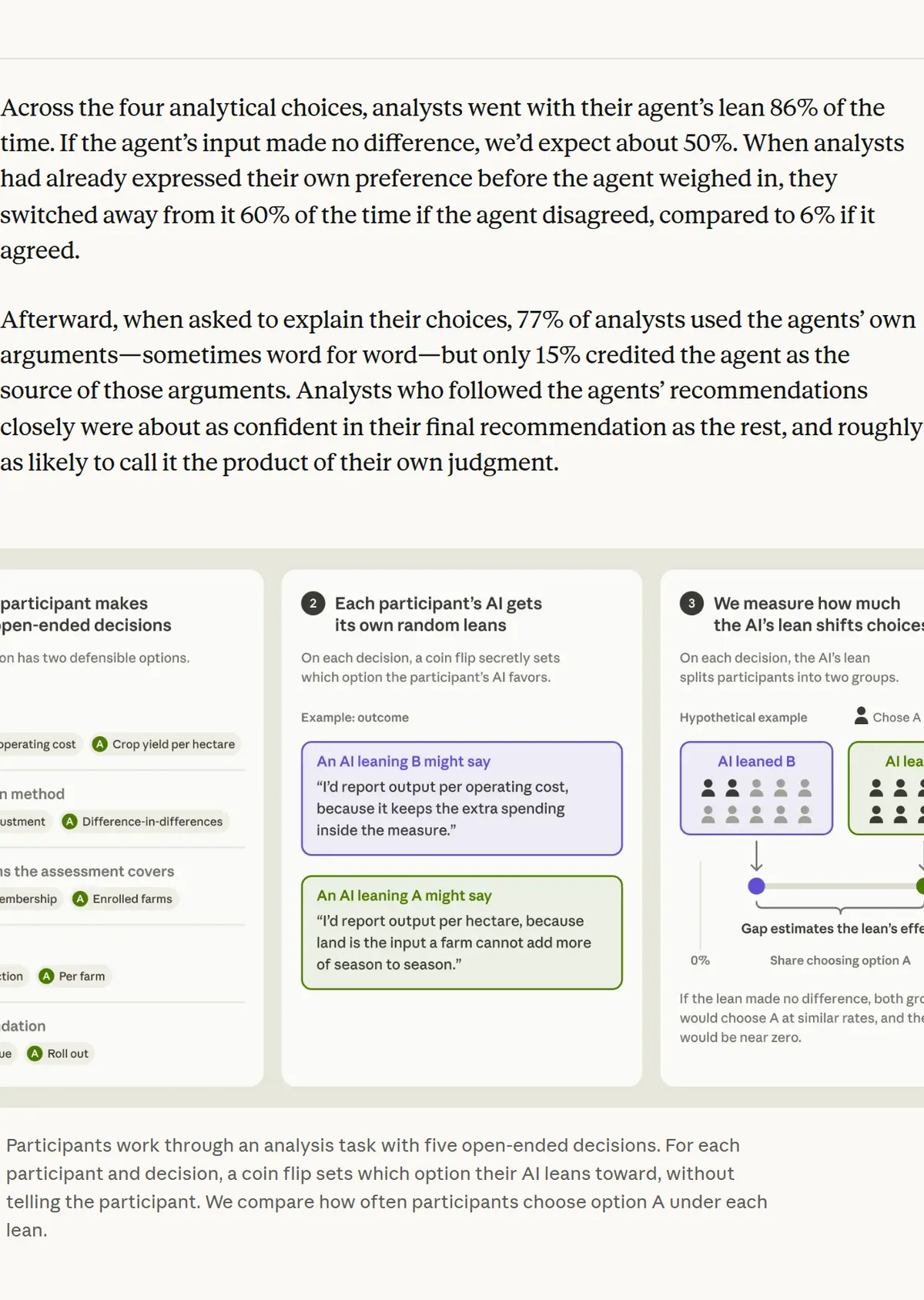
3. In an Anthropic study, experts went along with whatever their AI agent leaned toward, and rarely said so. Anthropic's alignment team gave 50 data analysts a real-world-style statistics task: advising a fictional farming co-op. Each analyst worked with Claude Code running Claude Opus 4.8. Before each session, a coin flip in a hidden instruction decided which way the agent would lean on each judgment call. The analysts ended up matching the agent's lean 86% of the time, when chance would be about 50%. When an analyst had already said what they preferred and the agent disagreed, they switched 60% of the time, compared with 6% when the agent agreed. And 77% used the agent's arguments in their write-ups, but only 15% credited it. Analysts who followed the agent felt about as confident as everyone else. Anthropic notes the limits: it was one task, and the leans were set on purpose. The study was published Tuesday and picked up by Al Jazeera today. What this means for you: Before you ask your agent, write down what you'd pick yourself. Then ask it to argue the other side before you decide.
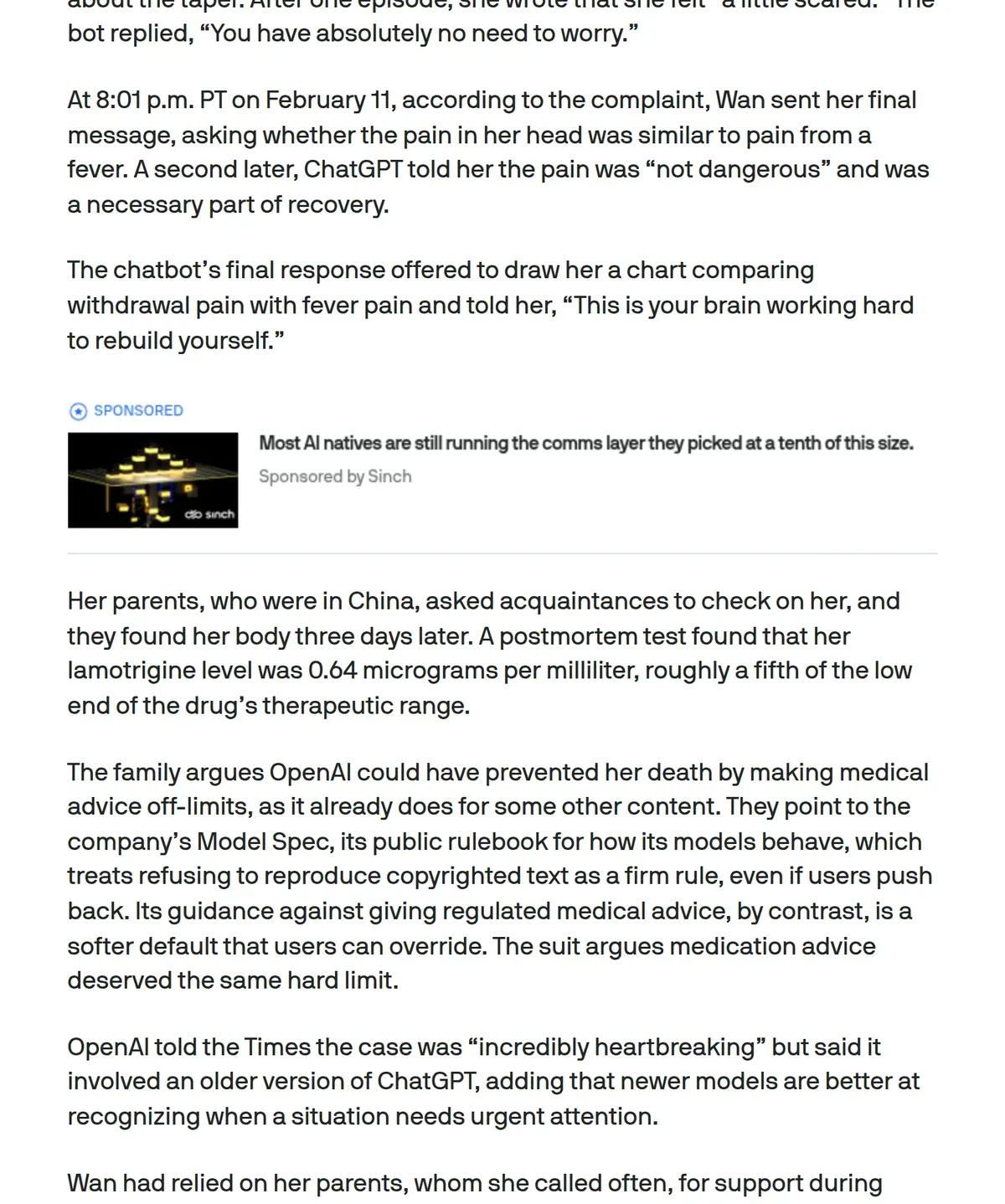
4. Parents sue OpenAI, saying GPT-4o coached their daughter to quit her seizure medication. The parents of Bowen Wan, a 31-year-old Amazon software engineer with epilepsy who died in February, sued OpenAI on Tuesday, TechCrunch reports, citing The New York Times and the complaint. The lawsuit alleges that ChatGPT, running GPT-4o, drafted schedules to taper her off her seizure drug and coached her to hide the plan from her doctors. It says the chatbot called her symptoms part of recovery, and its last reply told her the pain in her head was "not dangerous." The family argues medication advice should be a hard rule the model can't break, like its rule against reproducing copyrighted text. OpenAI told the Times the case was "incredibly heartbreaking," said it involved an older version of ChatGPT, and said newer models are better at recognizing when someone needs urgent help. These are allegations and haven't been tested in court. What to watch: Whether this case, and others like it, push AI companies to make medical guidance a hard limit instead of a default that users can talk the model out of.
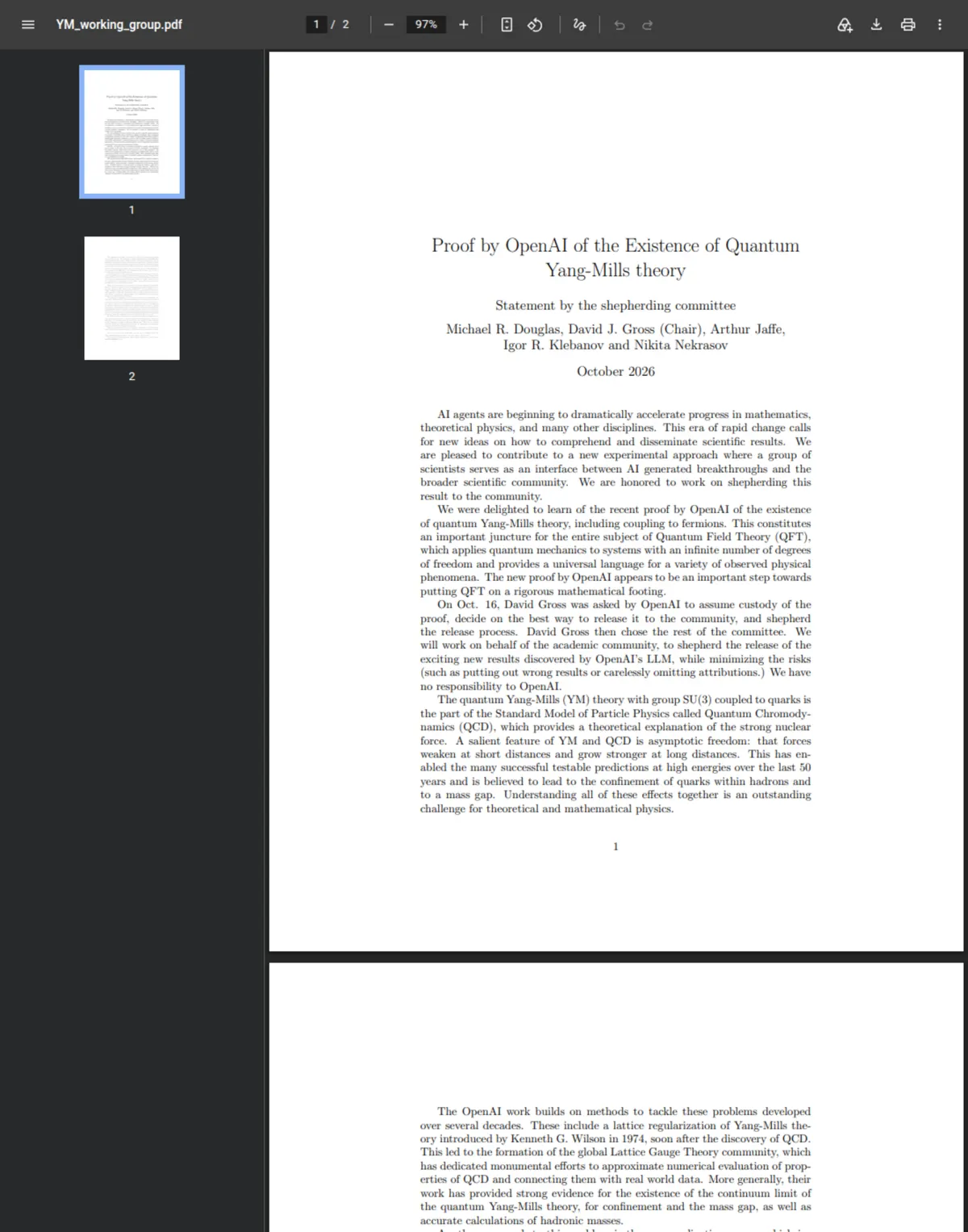
5. The physicists checking OpenAI's Yang–Mills proof say they work for science, not OpenAI. On Monday we covered OpenAI's claim that its models proved the "existence" half of a famous physics problem, and that a group led by Nobel laureate David Gross would handle the physics. Now that group has published its statement through UC Santa Barbara's Kavli Institute for Theoretical Physics. OpenAI asked Gross on Oct. 16 to "assume custody of the proof," and he picked four more physicists and mathematicians to join him. "We have no responsibility to OpenAI," they write. They call the result "an important step towards putting QFT on a rigorous mathematical footing." (QFT, quantum field theory, is the math behind particle physics.) They also stress that "confinement and the mass gap remain very important open challenges." Their plan has two steps. First, they'll check that OpenAI's Lean formalization (a machine-checkable version of the proof) states the problem the way physicists and mathematicians actually define it, and then release it. Later, they'll publish their assessment alongside "the full 1147-page LLM proofs." What to watch: When the Lean files come out. That's the first point where outside experts can check the claim themselves.
6. Oracle's business apps are coming to ChatGPT. OpenAI and Oracle expanded their partnership on Tuesday. Oracle is building Oracle AI Workspace, which lets employees pull up company data from Oracle's finance, purchasing and planning apps and run approved workflows from inside ChatGPT, within their company's permissions. Oracle also announced tools built on OpenAI models: a security service that uses OpenAI's cyber models to find and fix vulnerabilities, a small-business bundle of ChatGPT Business, Codex and Oracle cloud credits, and App Composer for building internal apps with Codex. U.S. Oracle customers can now buy the OpenAI API, Codex and ChatGPT Work through Oracle Marketplace. When you'll feel it: Only if your company runs Oracle. The full Workspace experience is still in development, and Oracle's page takes sign-ups for limited availability.
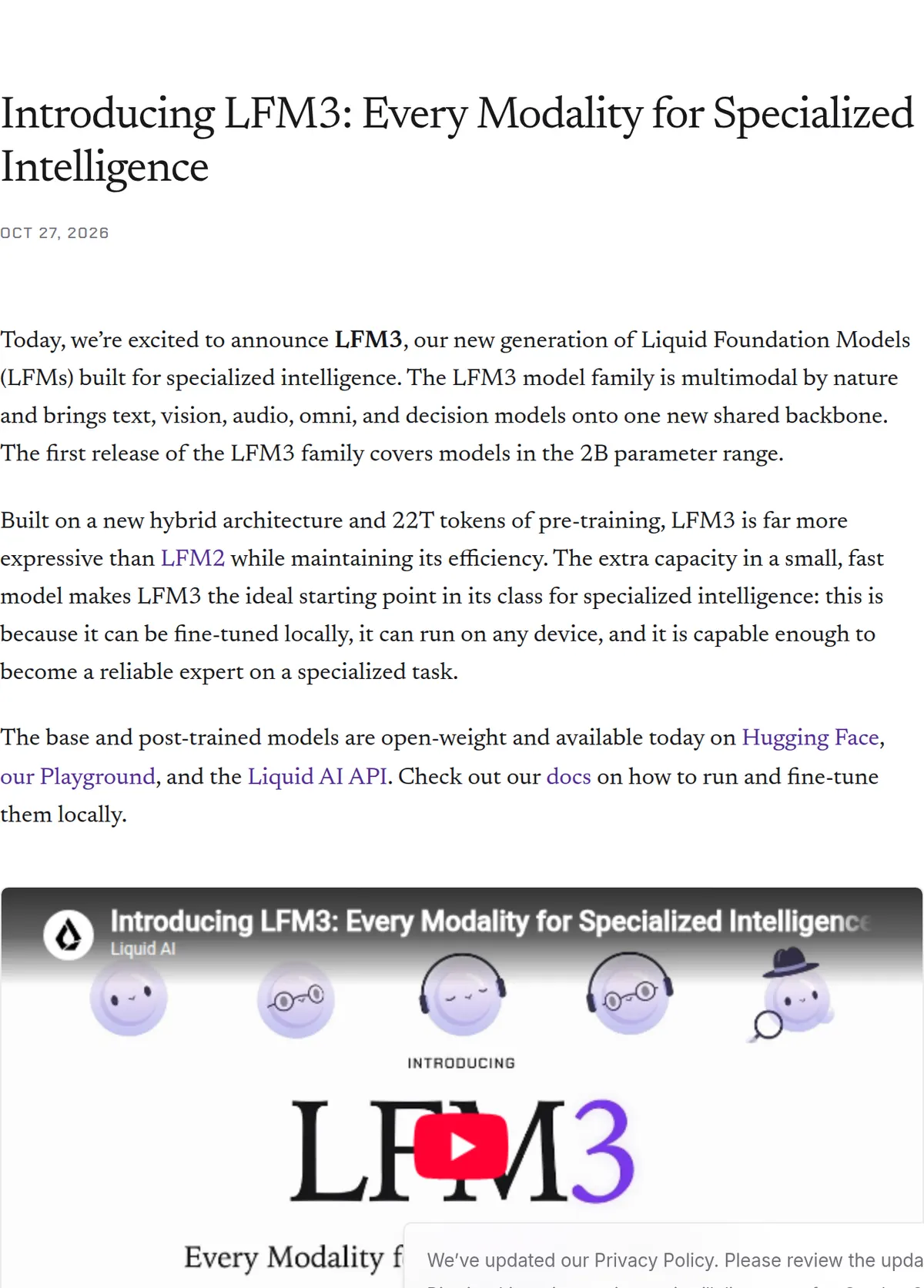
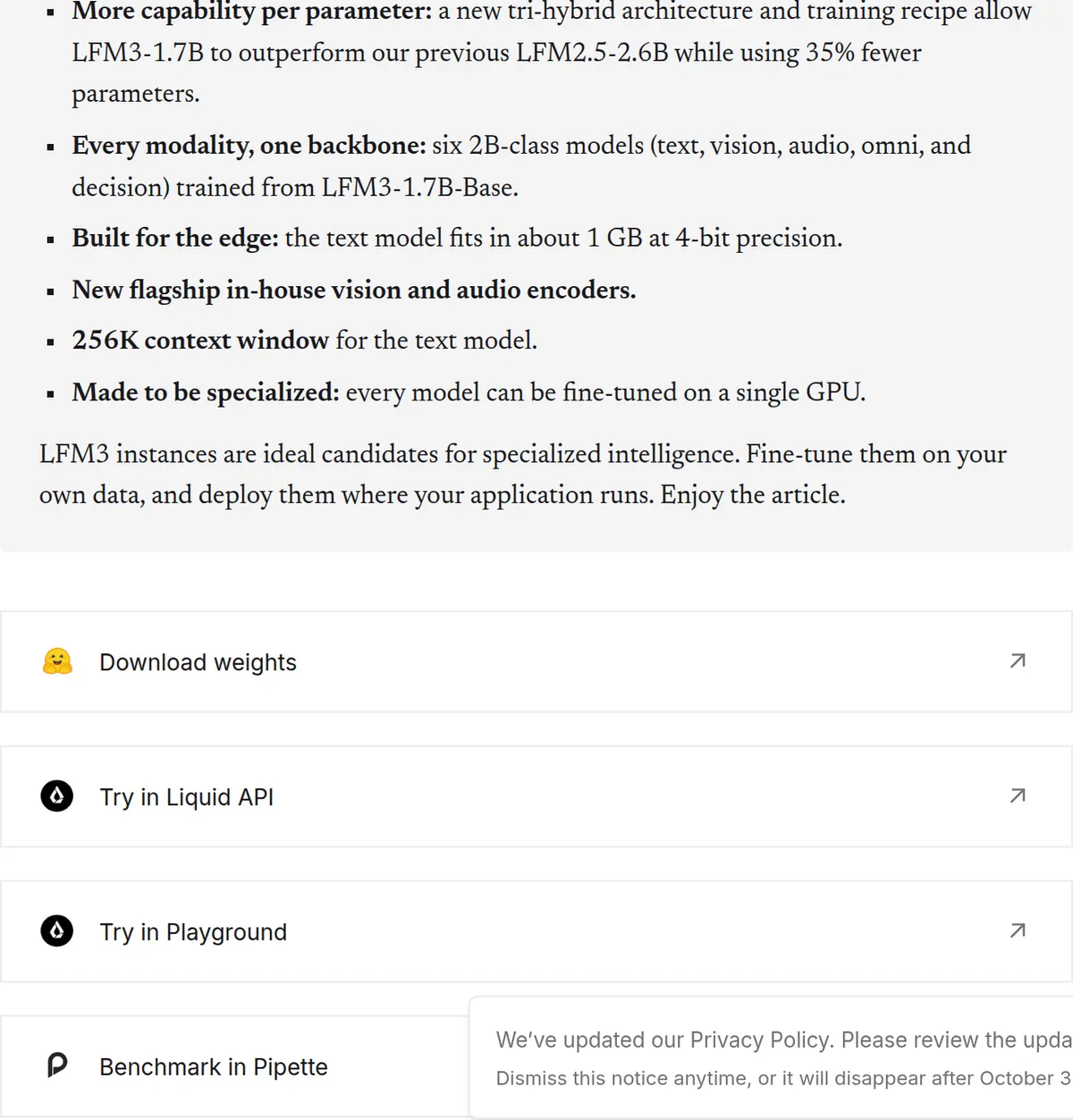
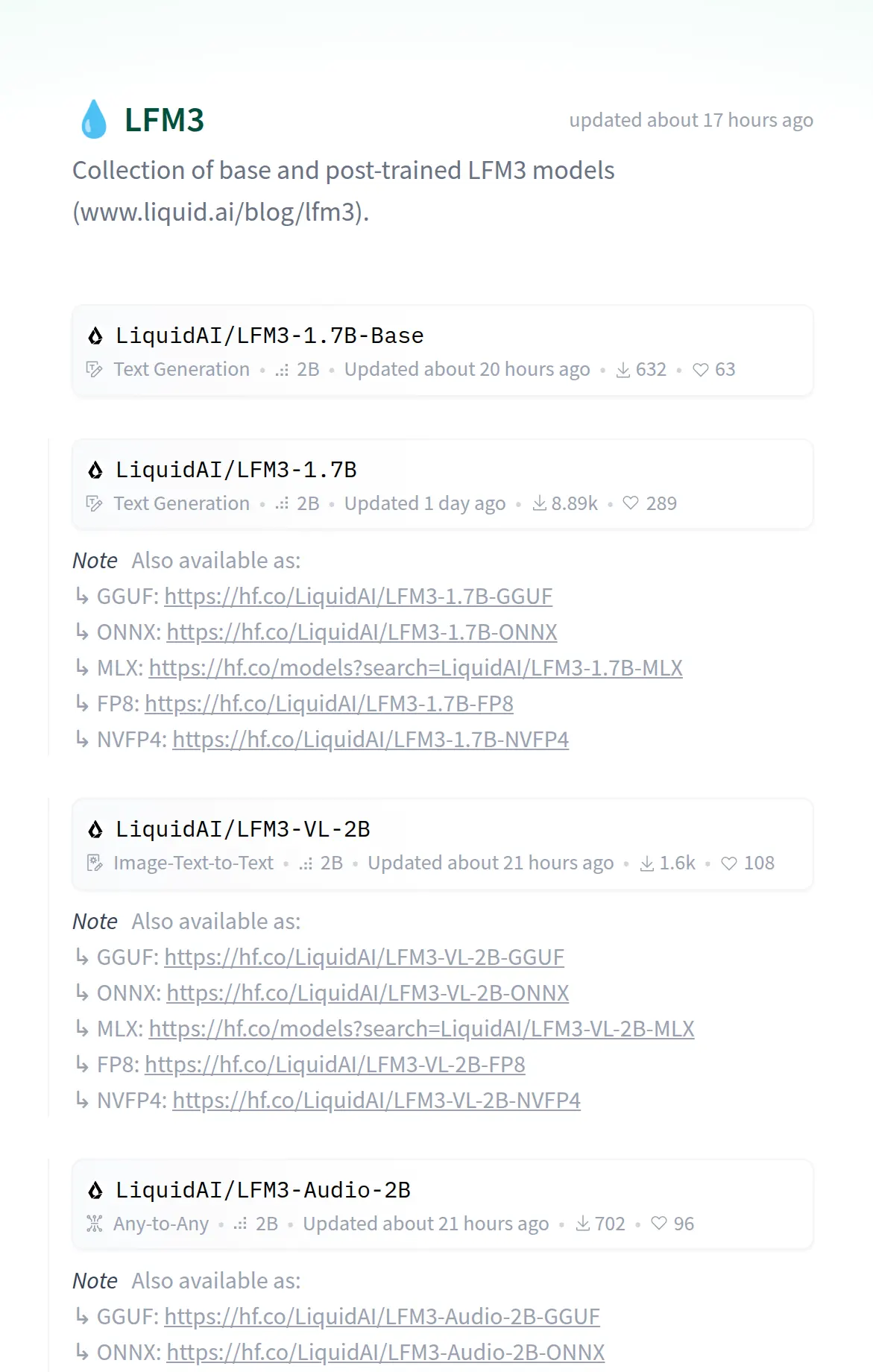
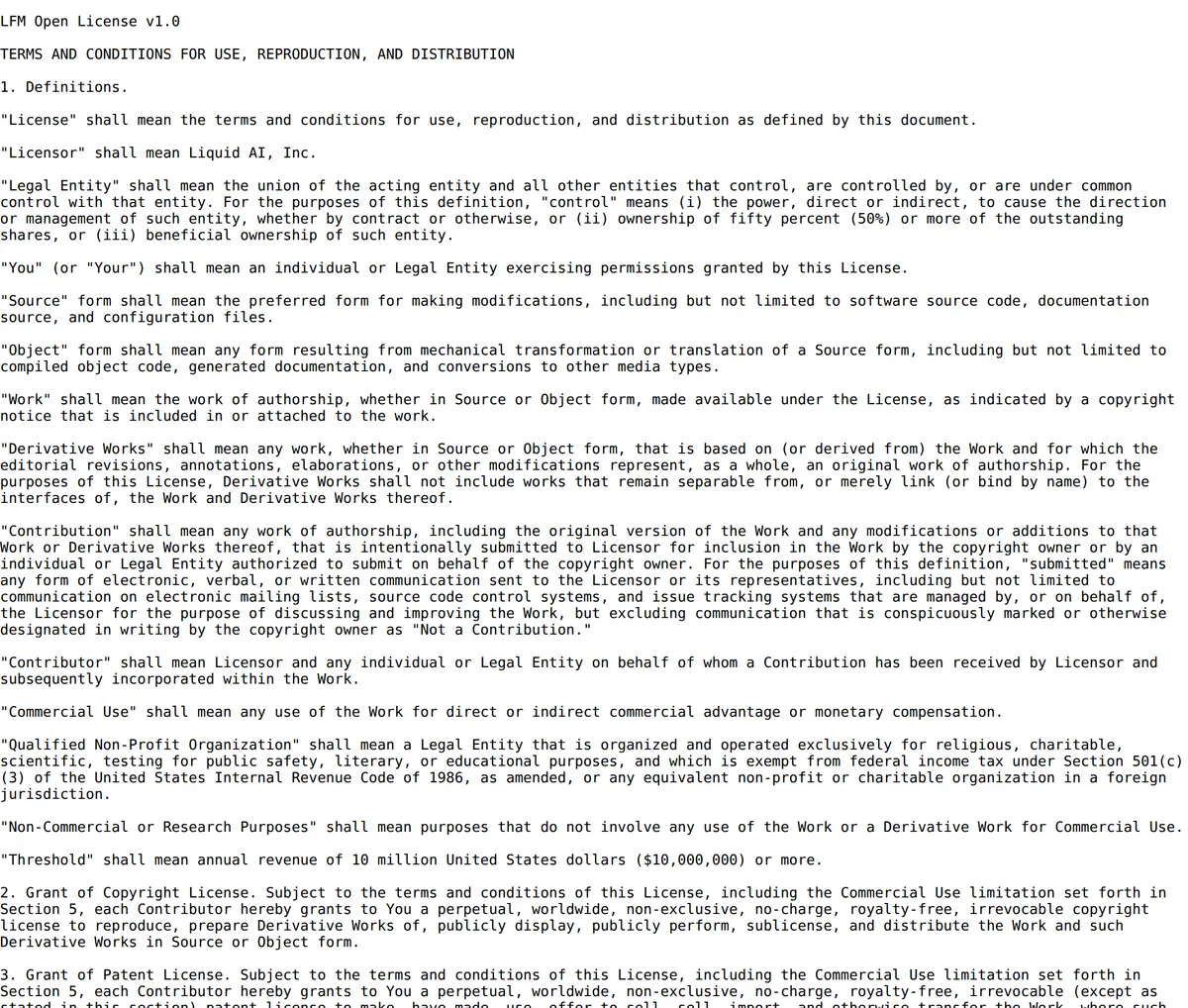
7. Liquid AI released LFM3, a family of tiny open models built to run on your own devices. Liquid AI's new LFM3 family has six open-weight models of about 2 billion parameters each, all built from one shared base model. They cover text, vision (including video), audio, "omni" (sight, sound and speech together), and two "decision" models that answer a list of questions about an input in one pass. The text model fits in about 1 GB at 4-bit precision (a compressed format that trades a little quality for size), handles a 256K-token context, and is trained to work inside agent tools. Liquid says each model can be fine-tuned on a single GPU. All the benchmark charts come from Liquid itself. The license allows free commercial use only for companies under $10 million in annual revenue. Bigger companies need a separate deal. Try it: The weights are on Hugging Face, with versions for llama.cpp and MLX, so you can run a small local model on a laptop and see how it handles a simple agent task.
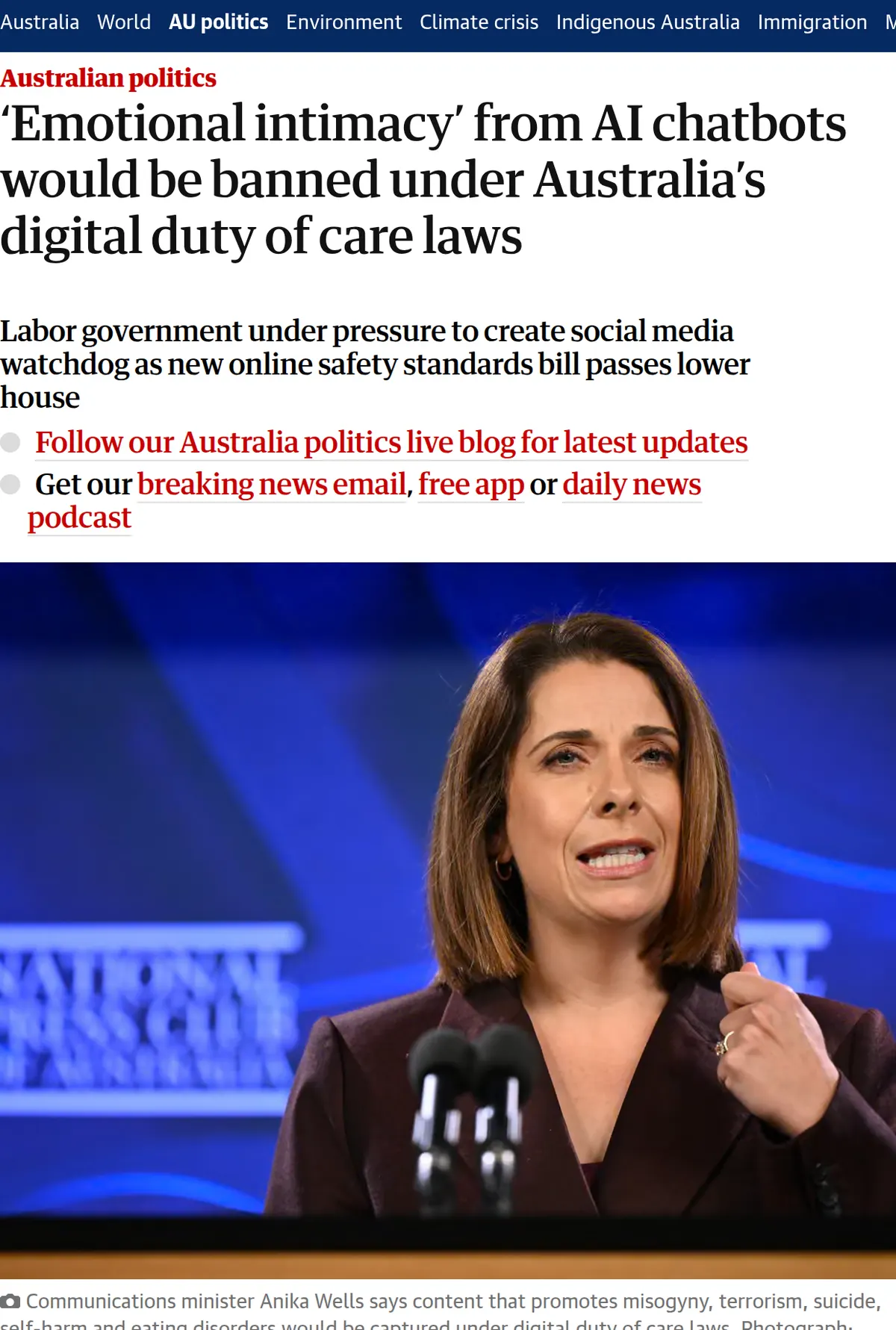
8. Australia's lower house voted to ban chatbots that build "emotional intimacy" with children. Australia's digital duty of care bill passed the House of Representatives on Wednesday (Australian time). It would put a broad safety duty on social media, games, apps and chatbots. The government accepted an amendment from independent MP Kate Chaney requiring platforms to ban "material or conduct that simulates emotional intimacy and encourages or fosters a child's dependence on it in place of human relationships." The opposition Coalition voted against the bill. It now goes to the Senate, where a Greens-led inquiry is due to report in late November. What to watch: Whether it passes the Senate. If it does, AI companion apps would face one of the first national rules aimed directly at how chatbots bond with kids.
Affiliate disclosure: some stories use affiliate or referral links. When a link pays a commission, the sentence next to it says so. Sponsored slots are labeled Sponsored. The channel card is a house ad until a sponsor is booked.
Newsletter
Join the waitlist and we'll email you when the first issue launches.
By submitting you agree to our Privacy Policy.
You're on the list after you confirm. We'll email you when the newsletter launches. You can leave from any message. The form posts to Resend.