

"Anthracite coal, Detail" by Clint Budd, CC BY 2.0, via Wikimedia Commons.

News
Google's Gemini 4 Carbon now tops Artificial Analysis's index, two weeks after Argon. At first, though, only some cyber defenders can use it.
Google announced Gemini 4 Carbon on Wednesday, two weeks after Gemini 4 Argon, calling it its strongest model for cybersecurity and long tasks.
Google announced Gemini 4 Carbon on Wednesday, two weeks after it launched Gemini 4 Argon, calling it "our strongest model with state-of-the-art cybersecurity and long horizon capabilities" (Google, Sundar Pichai on X).
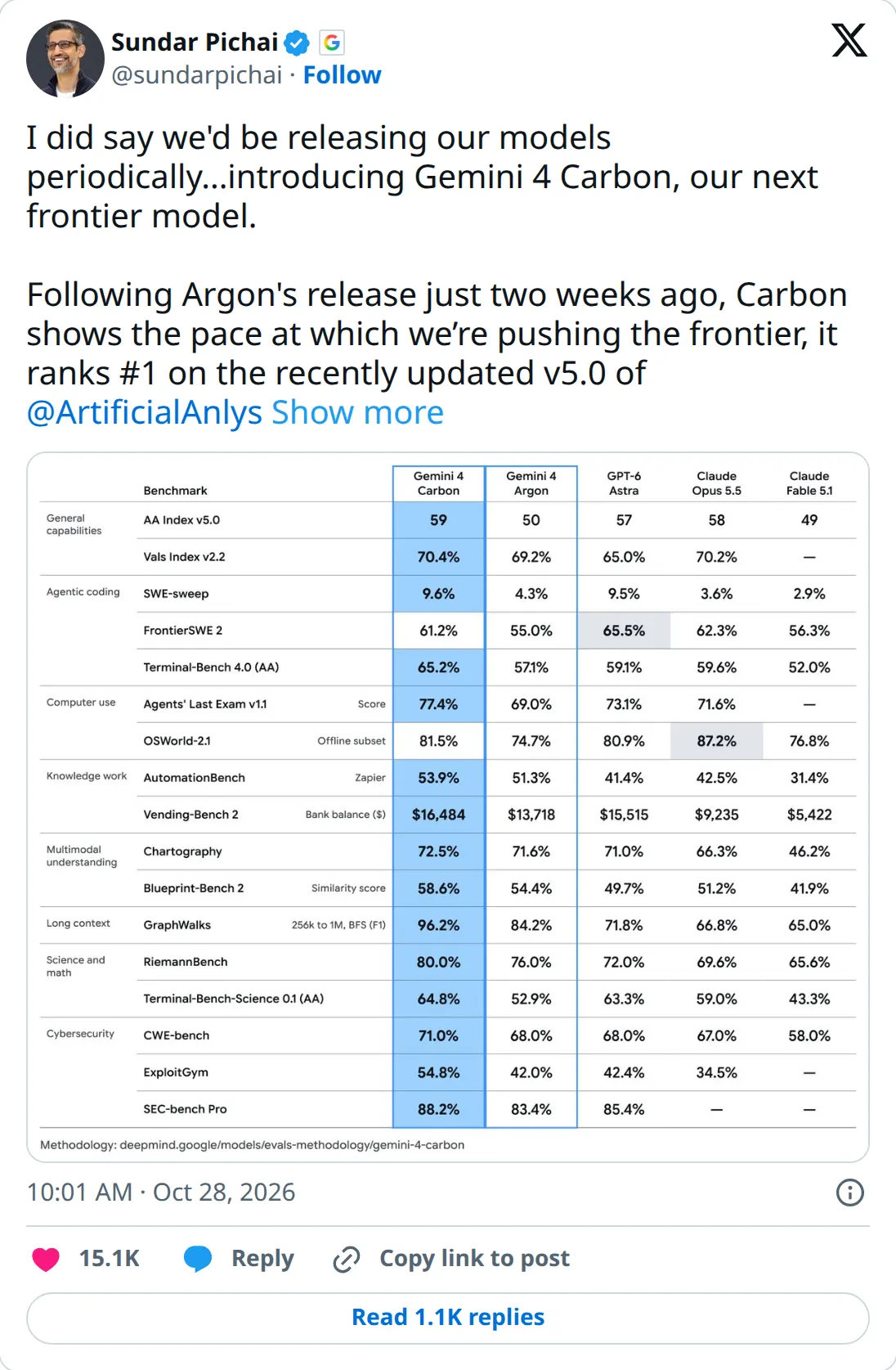
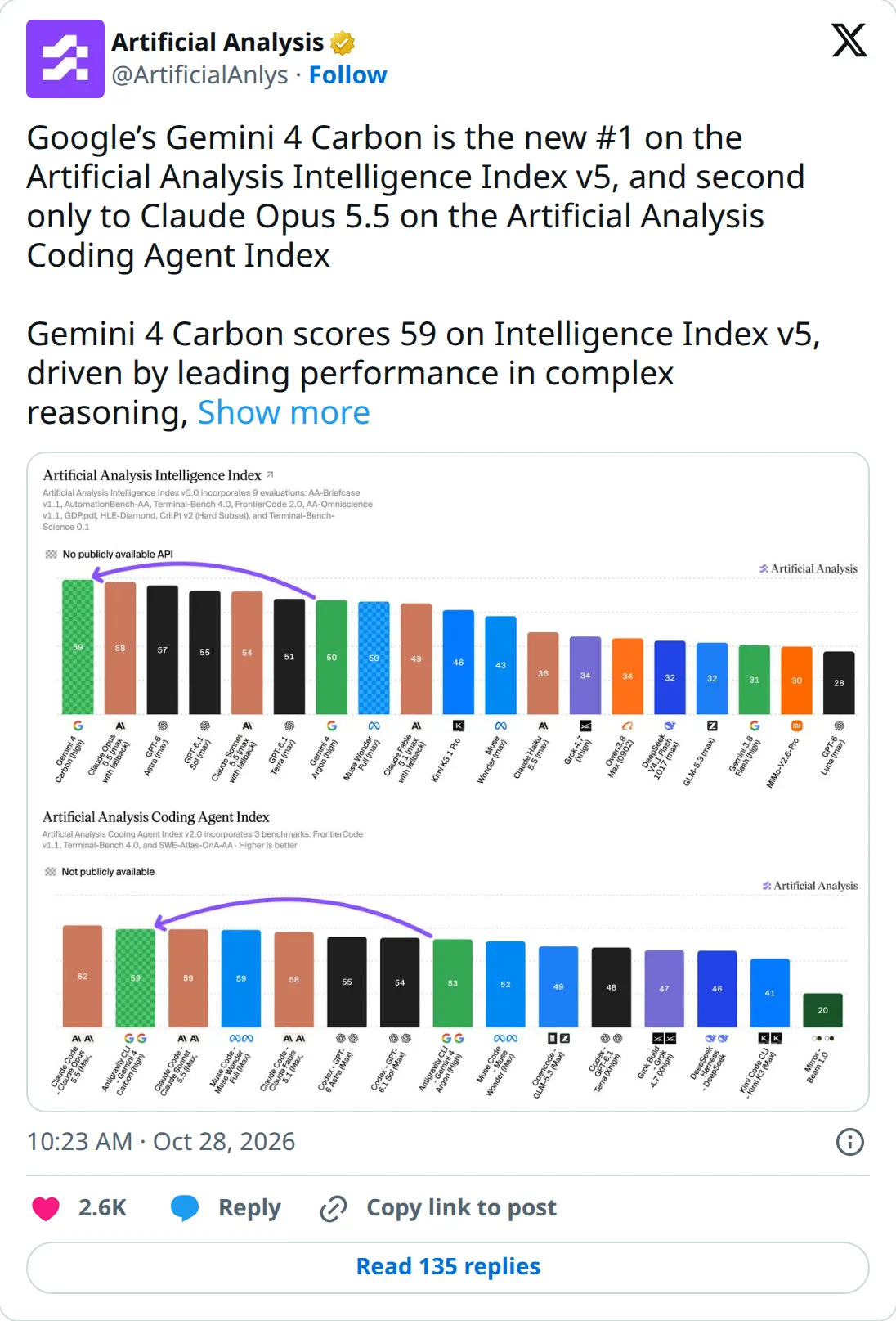
Google says Carbon can keep working on hard tasks for days "without getting stuck or taking shortcuts" (Google DeepMind on X). Its security and safety numbers are Google's own tests: for example, it says Carbon writes more than twice as much secure code as Argon and triggers almost 80% fewer high-severity misalignment alerts. Outside tests back up the headline. Artificial Analysis puts Carbon #1 on its Intelligence Index v5 with 59, a point above Claude Opus 5.5, and first in four of its nine evaluations. It also notes Carbon's hallucination rate rose from 4% to 11%, though that's still the second lowest it has measured (Artificial Analysis on X).
On Arena, where people vote between two answers without knowing which model wrote them, Carbon is #1 in text and #2 in agent tasks (Arena on X). Access starts small. Google says a subset of cyber defenders get it this week and more trusted partners follow through its Fairwind Program, with developers, businesses and consumers "as soon as possible." Google has listed an introductory API price of $2 per million input tokens and $10 per million output tokens, rising to $4 and $20 after that period. Artificial Analysis says no end date for the introductory price has been confirmed.
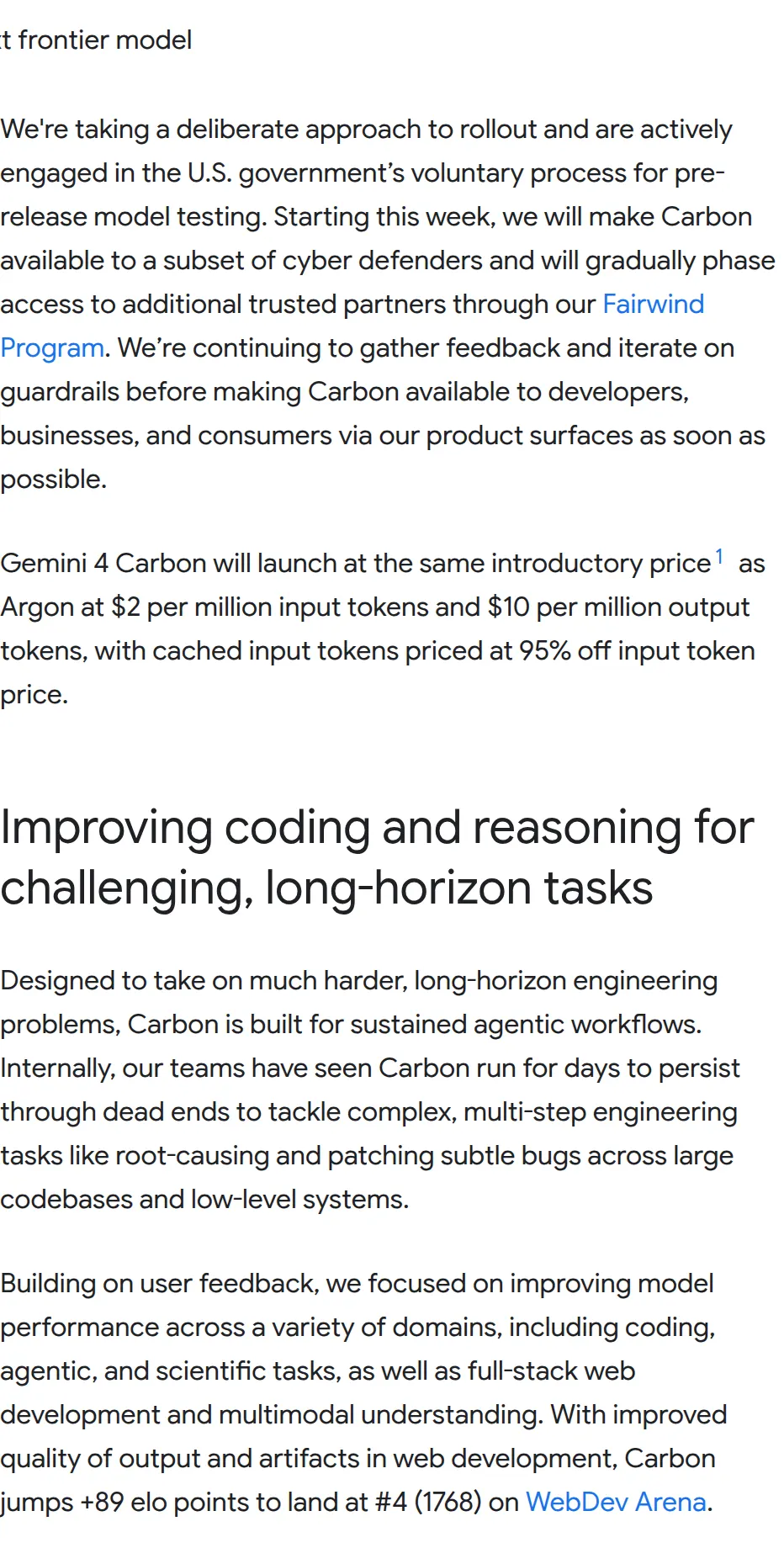
When you'll feel it: not yet for most people. Cyber defenders get it first, then more partners, and Google hasn't given a date for developers, businesses or the Gemini app. When the API opens, the introductory price is half the standard one, so check which price applies.
Affiliate disclosure: some stories use affiliate or referral links. When a link pays a commission, the sentence next to it says so. Sponsored slots are labeled Sponsored. The channel card is a house ad until a sponsor is booked.
Newsletter
Join the waitlist and we'll email you when the first issue launches.
By submitting you agree to our Privacy Policy.
You're on the list after you confirm. We'll email you when the newsletter launches. You can leave from any message. The form posts to Resend.