

Multiple hourglasses. Photo by Sauvagette, CC BY-SA 4.0, via Wikimedia Commons.

Model & Plan Comparisons
What people are saying about Kimi K3.1 Pro after its first days
We read 148 posts on X from October 23 to 26. Quota drain in Kimi Code is the loudest complaint, the October 25 reset drew mixed reports, and 3D builders are the happiest.
This is a sample, not a survey. Between October 23 and the morning of October 26, 2026, we read 148 posts on X that mention Kimi K3.1 Pro, across six keyword searches. Most were news recaps, reposted benchmark charts, promotion, or replies with nothing first-hand in them, and we set those aside. That left 27 posts, from 25 accounts, by people describing their own use or their own tests. We quote them word for word, typos included, with the date in Pacific Time. We did not verify their claims, and the people who post about a new model in its first days are not a random sample of the people who use it. A theme below needs at least two independent accounts. Single reports are labeled as single reports. Where an account's bio says it builds a competing product or sells AI content, we say so.
What Kimi is selling, in brief
Moonshot AI launched Kimi K3.1 Pro on October 23. We covered the launch in our news post. Here is how you can get it, as read on Kimi's own pages on October 26, 2026. Prices are in US dollars before tax.
| Where | What you get | What it costs |
|---|---|---|
| Kimi API | K3.1 Pro, pay as you go | $2 per million input tokens, $10 per million output, $0.20 per million cached input. The Highspeed version is $4 and $20. |
| Kimi membership Plus | K3.1 Pro (standard speed), Kimi Code | $19 a month, or $15 a month billed annually ($180) |
| Pro | 2x agent credits, K3.1 Pro Highspeed | $39 a month, or $31 billed annually ($372) |
| Max | 5x agent credits, Highspeed | $99 a month, or $79 billed annually ($948) |
| Ultra | 10x agent credits, Highspeed | $199 a month, or $159 billed annually ($1,908) |
The Kimi Code page says Highspeed runs "about 2-3× faster" and uses "2× credit usage". Kimi does not print how many requests or tokens a plan's quota holds.
The rules changed for new members. Kimi's membership docs say that for new members "the weekly quota limit is removed, and only the rolling 5-hour rate window remains", on top of a monthly total. When the monthly total runs out, "Kimi Code quota is frozen until the monthly quota resets or you upgrade." Members on the older plans keep a quota that refreshes every 7 days, with no rollover. All devices and API keys on an account share one quota. Paid "Extra Usage" top-ups are billed in Chinese yuan, start at ¥25, and are "generally non-refundable".
Moonshot also said it will publish the full model weights by November 4, 2026 (vendor claim).
Theme 1: Kimi Code quotas ran out fast at launch
This was the most common complaint by a wide margin. Eight of the 25 accounts we kept say the quota ran out far sooner than they expected, including people on the Max and Ultra plans. One more passes the complaint on secondhand.
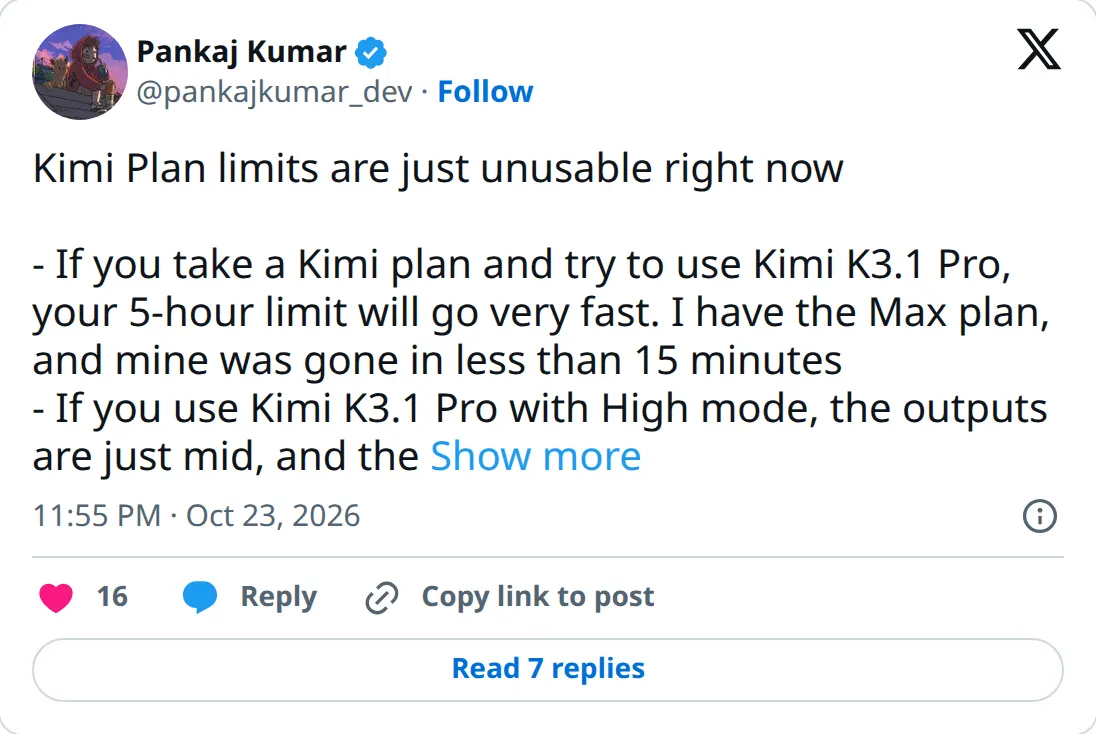
On the Max plan, @pankajkumar_dev wrote on October 23: "If you take a Kimi plan and try to use Kimi K3.1 Pro, your 5-hour limit will go very fast. I have the Max plan, and mine was gone in less than 15 minutes". The same post advised: "For now, I would suggest waiting for better limits before buying their plan".
On the $200 plan, @bwnyng posted on October 24: "I'm on the $200 plan and burned through two 5-hour quotas AND 10% of my monthly quota in under six hours using K3.1 ??? And it's slow as hell. Can I get a refund???"
@aipulseda1ly, an account that describes itself as tracking AI model news, wrote on October 23: "I hit the limit on my $100 Kimi Code plan in 20 minutes, in one session, running Kimi K3.1 Pro on high effort." It blamed capacity rather than the model: "Moonshot just has very limited compute". That is the poster's view, not something Moonshot has said.
@atomtanstudio, on Ultra, wrote on October 23: "Kimi Code does absolutely chew through your 5 hour limits even on the Ultra plan. This is FAR more expensive usage wise than Opus 5.5." @Layton_Gott gave a reason the same evening: "K3.1 Pro is thinking-only and defaults to max effort, so I was burning through it ridiculously fast." @CodeGuta said on October 25: "I burned a 5-hour Max window in 7 minutes before I could finish one comparison."
Two more accounts are briefer. @PovilasKorop, who runs a coding leaderboard, noted on October 24 that "Subscription usage limits are reported to be very bad". @rsh_nexa wrote: "Kimi k3.1 pro Usage is Horrible". That account's bio says it is building Nexa, an AI workspace that competes for the same users.
The counterpoint. One early report shows how confusing the setup was. Before his Ultra post above, @atomtanstudio wrote: "I think I might be doing it wrong. Take a look at my usage. See how Kimi Code is empty? I am using the Kimi app, but not Kimi Code". Kimi has a chat app and a separate Kimi Code tool, and they drew down the quota differently for him. Also, @darekgusto pointed out on October 25 that "Kimi has no weekly limits", which matches the docs for new members. So the 5-hour and monthly caps are the ones that matter, depending on when you signed up.
Theme 2: The October 25 reset drew mixed reports
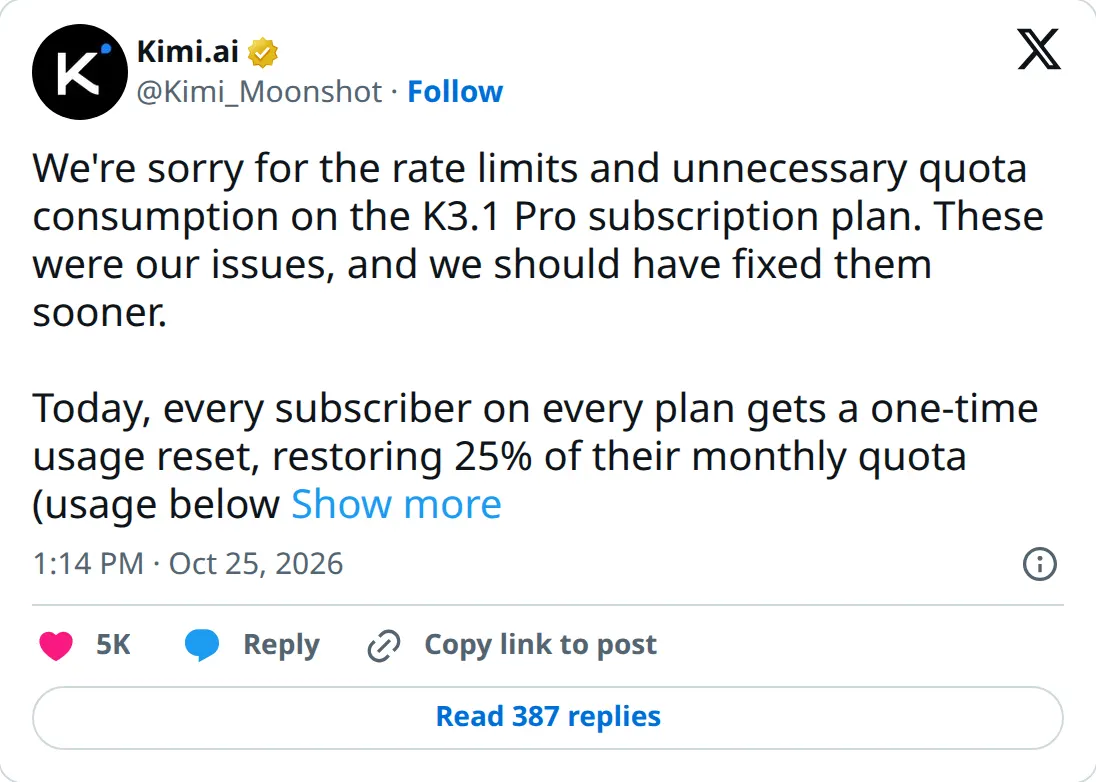
On October 25, the Kimi account apologized: "We're sorry for the rate limits and unnecessary quota consumption on the K3.1 Pro subscription plan. These were our issues, and we should have fixed them sooner." It promised that every subscriber gets "a one-time usage reset, restoring 25% of their monthly quota (usage below 25% resets to zero), equal to one week of usage", visible "by end of day PST". It said it was also "reducing unnecessary subagent calls and output length, so your quota goes further." Those are vendor claims.
Some people say usage got lighter. @atomtanstudio tested again that afternoon: "Testing the updated limits in Kimi Code desktop. Much improved at 8% to create the attached Kinetic type lyric video. It's nowhere near Opus 5.5, but it's no slouch." Even before the apology, an account with no followers reported on October 24 that "the usage drain looks much slower than when k3.1 was just rolled out."
Others say it is not enough, or has not arrived. @thegitai, whose bio says it is building a product called TheGitAI, wrote on the morning of October 26: "My monthly usage is still at 20%, exactly where it was 48 hours ago when I stopped using Kimi. The promised reset hasn't happened yet for me." The same post said "Quota consumption has improved since launch. Still behind Claude Code, but much better than day one." @h581098 wrote the same morning: "I ran just 3 prompts on Kimi K3.1 Pro and my entire usage quota was drained. THREE prompts. Absolutely ridiculous for a paid subscription. Kimi admits its quota system has issues, but a 25% reset doesn't fix this."
The counterpoint. These are reports from the first day after the change. We could not check anyone's usage bar, and we can't tell yet whether the lighter usage holds up.
Theme 3: 3D work gets the warmest reviews, and cost comparisons cut both ways
Even people who criticize the limits make an exception for 3D. @Layton_Gott wrote: "Kimi K3.1 is the best model I've ever used for 3D and game development... and feels bench-maxed for basically everything else." The post lists Unity, Unreal, Godot, Three.js and Blender, and ends: "I'd really only use this model for 3D or game development as of now." @cedric_chee wrote on October 23: "Design taste now feels closer to Astra-class models," and "Open models are closing in on the frontier in 3D work." @softpoo ran a Blender MCP test and said K3.1 Pro "wins the open source test today" at "time 9m10s".
@sakatayasha built "a full interactive 3D human brain anatomy explorer" in "only 49 mins" and wrote: "this is the first time a model built me something I'd actually send to a student". Not everyone was impressed. @chikitleung built a 3D Noah's Ark in OpenCode and wrote: "It did not feel slow, but still no "wow" moment. More like a 0.1 upgrade."
Several accounts posted same-prompt runs against Claude Opus 5.5 with dollar figures. The figures go both ways:
- @noclipepe, a showcase account for AI visuals, posted on October 26 a Halloween animatronic test: "Opus 5.5: 31m 13s, $5.92" and "Kimi K3.1: 21m 18s, $0.56". The verdict: "Opus built the cleaner X-ray. Kimi showed more of the machine for 10× less."
- @BuildFastWithAI, which sells AI app tutorials, posted on October 23: "Kimi: $1.57 | ~13 min wall time" against "Opus: $5.58 | ~29 min wall time", with "Opus still catches more details".
- @thegreatest_sv, an AI content account, posted a Lego build on October 24. Opus took "6m 40s", "0 retries", "$12.40". Kimi took "8m 25s", "2 retries", "$8.91". "Both hit 3915/3915."
- @semichenkko, whose bio says "I compare and test ai models // team @CELE8EX", compared Kimi with a cheaper model on October 26: "minimax m3.1 flash, $0.21" against "kimi k3.1 pro, $6.10", and wrote that it "paid 29x more for the worse one".
The counterpoint. These are showcase posts from accounts that make comparison content. They show single runs on one prompt each. They are not a cost benchmark. The API prices behind them are published, but subscription users pay in quota, not dollars, so these numbers don't tell you how far a plan goes.
Theme 4: Doubts about everyday coding
Outside 3D, the coding reports lean skeptical. @Layton_Gott's summary rated "normal coding: good, but not Opus 5.5 level" and "general agent work: fine, but not what they claim". @pankajkumar_dev wrote that "the benchmarks and real-world performance of Kimi K3.1 are different, so don't assume it's an openSource version of Opus 5.5." @debugsenpai, whose bio says it runs an AI wrapper product, tested it against Claude Sonnet 5.5 and wrote: "Sonnet 5.5 performed much better in my tests, despite their similar API pricing." @balubabear1312 put it harshly: "Anyone whos tested Kimi K3.1 Pro knows its complete garbage.. Id even pick Sonnet 5.5 over it".
The counterpoint. @PovilasKorop's leaderboard put K3.1 Pro at "Much faster/cheaper on API pricing than K3", with a score "same as K3 in Kimi Code, but better than K3 in OpenCode". @atomtanstudio found it "much better in Kimi Code" than in the chat app. Where you run the model seems to change people's results.
Theme 5: Questions about the benchmark setup
A smaller group questioned how Moonshot measured the model. Kimi's launch blog reports 65.7% on Terminal-Bench 4.0, against 66.4% for Claude Opus 5.5 and 58.2% for GPT-6 Astra, "evaluated with the Claude-Code harness" (vendor claim). @scaling01 asked on October 23: "I wonder why Kimi-K3.1 Pro is evaluated using Claude Code harness on basically every benchmark". @gibbsfree8660, a small account that summarizes evaluations, noted on October 25 that Artificial Analysis reported 67% on the same benchmark. It pointed out that Kimi's competitor scores "were taken from their respective official blogs or the Terminal-Bench leaderboard, rather than being rerun alongside K3.1 Pro under identical conditions." @mrru5s3ll suggested on October 25: "Give both models the same messy dependency upgrade and compare review time and total cost for a patch you'd merge."
What we left out
- Moonshot's own posts, apart from the apology, which we quote as a vendor statement.
- A same-prompt "fart-powered backflip" comparison video. It is a real post, but we left it out for taste.
- Benchmark chart reposts, news recaps, giveaway posts, and replies with no first-hand use.
- Parts of quoted posts that were links, hashtags, or calls to follow.
What to weigh
- When you signed up. New members have no weekly cap, only the 5-hour window and a monthly total. Older plans still refresh weekly. Most launch complaints are about the 5-hour window.
- Whether the fix holds. The reset and the cut to subagent calls are a day old as of this writing. Early reports after the change are mixed.
- Which effort level and app you use. Several posters tie fast drain to max effort, Highspeed's 2× credit use, or Kimi Code versus the chat app.
- What you're building. 3D and visual work drew the most consistent praise. Everyday coding drew more doubts, and most head-to-head posts ranked Opus 5.5 higher on quality.
- API versus plan. On the API you pay per token at published rates. On a plan you pay in a quota Kimi does not publish in numbers.
Sources
- Kimi, "Kimi K3.1 Pro" launch blog, October 23, 2026: https://www.kimi.ai/blog/kimi-k3-1-pro
- Kimi API pricing, read October 26, 2026: https://platform.kimi.ai/docs/pricing/chat
- Kimi membership pricing, read October 26, 2026: https://www.kimi.com/membership/pricing
- Kimi Code plans, read October 26, 2026: https://www.kimi.com/code
- Kimi Code membership docs, read October 26, 2026: https://www.kimi.com/code/docs/en/kimi-code/membership.html
- @Kimi_Moonshot, October 25, 2026: https://x.com/Kimi_Moonshot/status/2114450610724708492
- User posts quoted (all retrieved October 26, 2026):
- https://x.com/pankajkumar_dev/status/2113886963472400567 (Oct 23)
- https://x.com/bwnyng/status/2113943018348904824 (Oct 24)
- https://x.com/aipulseda1ly/status/2113843109352108472 (Oct 23)
- https://x.com/atomtanstudio/status/2113757886975447084 (Oct 23)
- https://x.com/atomtanstudio/status/2113724616040763718 (Oct 23)
- https://x.com/atomtanstudio/status/2114475719648743441 (Oct 25)
- https://x.com/Layton_Gott/status/2113809753541410864 (Oct 23)
- https://x.com/CodeGuta/status/2114455753692209305 (Oct 25)
- https://x.com/PovilasKorop/status/2114046844380537187 (Oct 24)
- https://x.com/rsh_nexa/status/2113714812991729808 (Oct 23)
- https://x.com/darekgusto/status/2114476202228605003 (Oct 25)
- https://x.com/EveHycin/status/2114179008711577803 (Oct 24)
- https://x.com/thegitai/status/2114711383686459425 (Oct 26)
- https://x.com/h581098/status/2114654704940843289 (Oct 26)
- https://x.com/cedric_chee/status/2113849758515425670 (Oct 23)
- https://x.com/softpoo/status/2113807862132887622 (Oct 23)
- https://x.com/sakatayasha/status/2114705736903307703 (Oct 26)
- https://x.com/chikitleung/status/2114707585001750998 (Oct 26)
- https://x.com/noclipepe/status/2114727475485819245 (Oct 26)
- https://x.com/BuildFastWithAI/status/2113888072983339504 (Oct 23)
- https://x.com/thegreatest_sv/status/2114011783476441136 (Oct 24)
- https://x.com/semichenkko/status/2114718986097098758 (Oct 26)
- https://x.com/debugsenpai/status/2113827106614637025 (Oct 23)
- https://x.com/balubabear1312/status/2113822213392740419 (Oct 23)
- https://x.com/scaling01/status/2113685186349355260 (Oct 23)
- https://x.com/gibbsfree8660/status/2114561366812217827 (Oct 25)
- https://x.com/mrru5s3ll/status/2114372502180995456 (Oct 25)
Affiliate disclosure: some stories use affiliate or referral links. When a link pays a commission, the sentence next to it says so. Sponsored slots are labeled Sponsored. The channel card is a house ad until a sponsor is booked.
Newsletter
Join the waitlist and we'll email you when the first issue launches.
By submitting you agree to our Privacy Policy.
You're on the list after you confirm. We'll email you when the newsletter launches. You can leave from any message. The form posts to Resend.